
What Is a Butler Training School?
WHAT IS A BUTLER TRAINING SCHOOL
A butler training school is a place where the skills a butler needs are trained systematically, until a student is ready to work in the field.
The Japan Butler Academy is the only butler training school in Japan with a campus of its own — a school you can actually attend, located in Odaiba, Tokyo.
This page sets out the practical points anyone considering this path should weigh: what is actually trained, how long it takes and what it costs, the formats available, and how to assess a school.
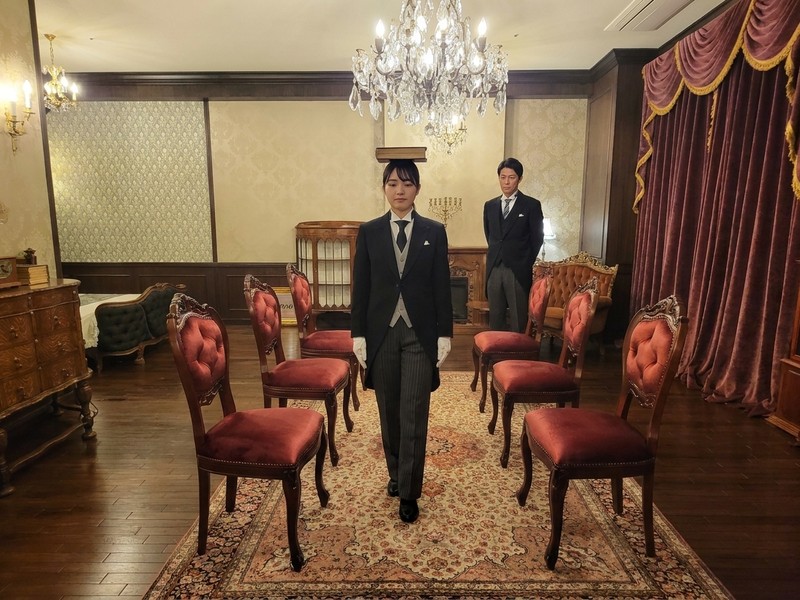
Posture is acquired through repetition, not through knowledge
DEFINITION
Being Taught Versus Being Trained
Learning and Being Trained
The phrase "butler school" suggests a place where knowledge is passed on.
What a butler training school takes on, however, goes beyond the transfer of knowledge: it reshapes the way a student uses their body until they are ready to stand in a real household.
The difference shows at the point of completion — whether a graduate merely knows something, or can perform it on the spot.
In butler training, something as simple as carrying a tray is repeated dozens of times after it has been understood in theory.
The instructor corrects the angle, the stride and the height of the gaze on the spot, until the same movement appears without conscious thought.
The intensity required differs greatly between someone exploring the world of butlers out of interest and someone intending to make a profession of it.
That distinction is the first thing to settle when considering a butler training school.
Knowledge Is Not the Finish Line
What is understood in a lecture becomes a skill only once it can be reproduced in hands-on practice and role-playing. Between understanding and reproduction there is always a stage of repeated training.
There Is a Standard to Measure Against
Vocational training requires a way to measure whether the standard has been reached.
At The Japan Butler Academy, completion requires an attendance rate of 80% or higher, and each course concludes with a written examination (30 minutes) and a practical examination.
What Remains Afterwards Differs
Knowledge fades with time, but technique held in the body remains. Successful candidates also receive a credential certified by The All Japan Butler Association, giving them a way to demonstrate what they have achieved.
FOUR DOMAINS
The Four Domains Trained at a Butler Training School
Four Domains of Training
The skills involved are wide-ranging, but they fall into four domains. None of them is completed in the lecture room alone; each is accompanied by hands-on practice and role-playing.
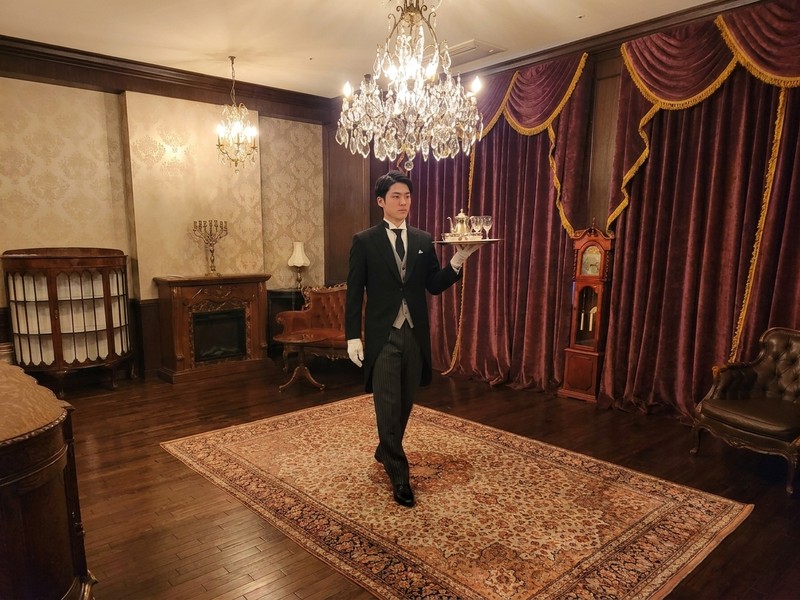
Technique and Table Service
Tea service, table setting, handling a tray, bearing and movement — the skills a guest sees directly. Everything down to stride length and the direction of a glance is trained into a form that never hesitates.

Household Operations and Stewardship
The unseen work: caring for tableware, silver, garments and supplies, keeping records, and coordinating with outside parties. Knowing what is where, and how much of it there is, determines the quality of service on the day.

Receiving Guests and Confidentiality
Reception from welcome to farewell, choice of words and calibration of distance, together with the professional ethic of never letting information travel.
Confidentiality is a discipline rather than a technique, but it too requires repeated reinforcement.

Judgement in Urgent Situations
A changed schedule, a sudden illness, an unexpected arrival. Where no manual exists, one must decide what comes first and who must be told. Role-playing across many scenarios shortens the time spent hesitating.
The four domains are not taught as separate subjects; they are handled together within a single practical exercise. The full picture of what is studied is set out on our Curriculum page.
View the CurriculumTIME & COST
How to Think About Duration and Cost
Time and Cost
When assessing a butler training school, it helps to look not only at the total figure but at the cost per hour of training — that is what makes it possible to judge how the commitment fits into daily life.
The three courses at The Japan Butler Academy are set out below by duration, attendance days, total training hours and tuition.
| Course | Duration | Attendance days | Total training hours | Tuition (incl. tax) |
|---|---|---|---|---|
| Essential | 1 month | 8 days | 48 hours | JPY 780,000 |
| Advanced | 2 months | 12 days | 72 hours | JPY 1,180,000 |
| Master | 3 months | 16 days | 96 hours | JPY 1,680,000 |

Work Backwards From the Hours
All classes are held at weekends, six hours a day (four 90-minute periods). Once the attendance days and total hours are known, the time butler training will require can be mapped onto your own schedule in advance.
Check the Payment Terms First
Payment is by bank transfer in a single instalment only; instalment plans and credit cards are not accepted. Students progressing to a higher course benefit from our transfer allowance, the details of which are published on the pricing page.
A Way In When You Are Undecided
If you are not ready to commit to a full course, our one-day seminar runs for six hours (JPY 33,000, incl. tax). The fee is credited in full against tuition if you enrol on a full course within one year of attending.
STUDY FORMATS
On-Site, On-Demand and Short Courses
Formats of Study
Study at a butler training school broadly takes three forms: attending in person, on-demand video, and short taster seminars. Each is suited to something different, so combining them according to your purpose is the practical approach.
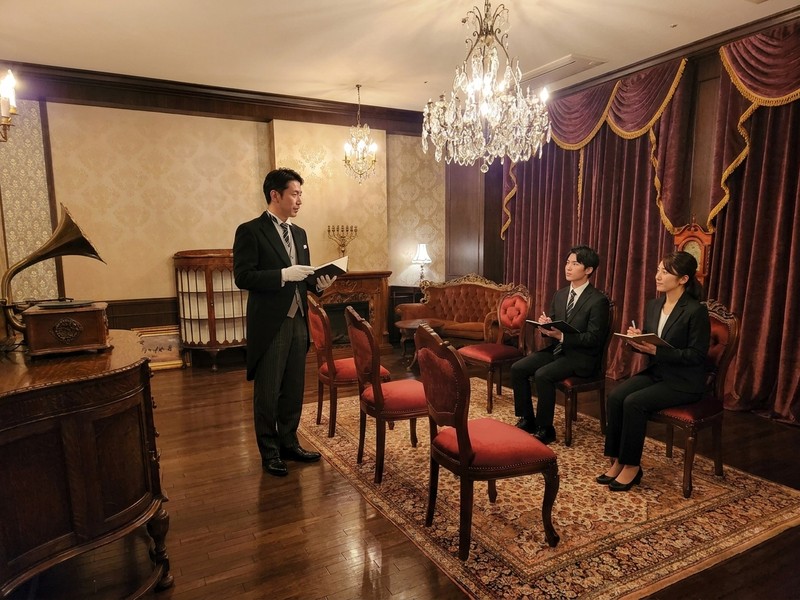
In Person
Hands-on practice and role-playing exist only in person.
The instructor watches the movement and corrects the angle or the balance on the spot — that exchange is the whole point of the format, and it is why the proportion of practical work matters when choosing a butler school.
On-Demand Video
Best suited to preparation and revision. The Japan Butler Academy runs a hybrid format that pairs in-person classes with on-demand video lessons for preparation and review, so that contact hours can be devoted to practical work and role-playing.
The One-Day Seminar
A format for deciding whether to proceed to a full course. Six hours are enough to see the instructors, the classroom and the pace of teaching for yourself before committing.
Three Checks on Studying While Working
Because every class falls at the weekend and runs for six hours, and because the knowledge component can be covered by on-demand video, those in weekday employment can attend to a plan.
For any school you are considering, three checks — which days classes fall on, how many hours each day runs, and whether there is a means of catching up — will tell you in advance whether you can sustain it.
HOW TO CHOOSE
A Checklist for Choosing a Butler Training School
A Checklist for Choosing
There are few butler training schools, and little comparative information about them. Rather than ranking one against another, the five points below are things you can verify for yourself.
Our own position on each is noted so that you have a concrete yardstick.
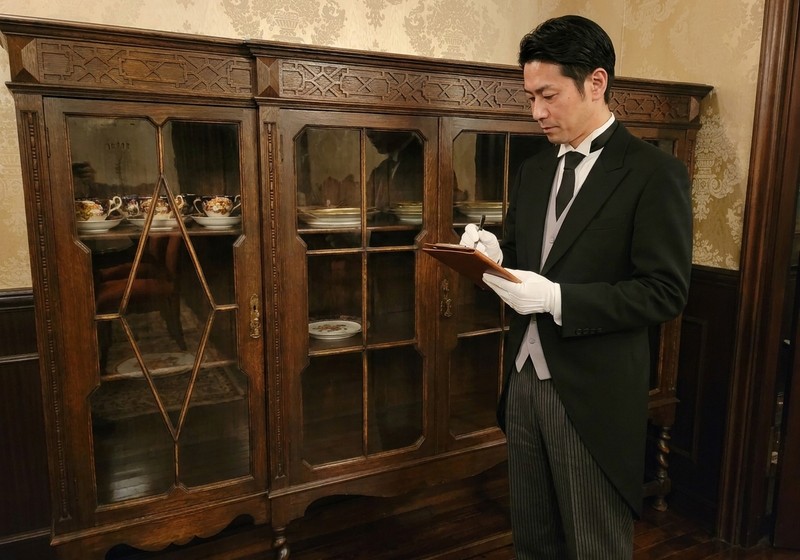
- 1
Is There a Campus You Can Actually Attend?
Confirm where the classroom is and whether practical work genuinely takes place there. Training in technique requires a space and the objects to work with.
As the only butler training school in Japan with a campus of its own, we hold all in-person practical work at our school in Aomi, Koto-ku (Odaiba), Tokyo.
- 2
Class Size and the Density of Individual Attention
The number of students in a class is a direct measure of how much instructor time is directed at you. We cap classes at six students (with a minimum of three to run), so that every detail of each student's technique can be examined.
- 3
What Is Certified on Completion?
Establish whether there is only a certificate of completion or a formal credential, and who awards it.
Depending on the course we award the Certified Associate Butler, Certified Professional Butler and Certified Master Butler credentials, each certified independently by The All Japan Butler Association as a private-sector credential.
- 4
Who Operates the School?
The identity of the operating body is what stands behind the curriculum and the credential. Our operating body is The All Japan Butler Association.
- 5
The Share of Practical Work and the Materials
Look at how much of the total hours is practical, and whether the teaching materials are properly structured.
We use a set of 15 specialist textbooks supervised by the Association (five each at foundation, applied and specialist level), assigned according to the course.
* These points are not criteria for ranking one school above another. They are simply a way of checking, against your own purpose — an interest to explore or a profession to build — whether the necessary conditions are in place.
AFTER COMPLETION
Where the Path Leads After Completion
Pathways After Completion
The skills acquired through butler training are not confined to the role of butler alone.
Any work that involves people, the ordering of a space and the anticipation of needs offers room to apply them.
Four directions are outlined below, alongside the pay bands reported in overseas markets — bands that rise with years of experience, which is one reason sustained training matters to those who stay in the field.
No public statistics for Japan could be confirmed.
For the detailed discussion of butler pay, see the butler job page (/butler-job).
Private Residences
A setting where household operations, stewardship and the reception of guests are handled as one.
It draws on all four domains directly, and the scope entrusted to each person tends to be broad.
A guide focused on the UHNW segment places UK private-residence roles at £65,000–£105,000, with a head butler at a large principal residence at £95,000–£150,000; at principal-residence level in the US the reported band is $110,000–$190,000.
In Monaco and the South of France, €6,000–€9,500 net per month is cited, and in Switzerland CHF 7,500–13,000 per month.
Live-in accommodation in London is often valued at a further £15,000–£25,000 a year.
Hotels and Refined Service Settings
Here technique, table service and guest reception carry the greatest weight. Because the work is done as a team, reproducing an agreed standard consistently is what earns recognition.
Compensation in this sector varies widely by property and market; the experience-linked structure described for private service is a useful reference point rather than a promise of any particular figure.
Raising Standards Where You Already Work
A direction that assumes no change of employer. The habit of reading ahead and the calibration of distance translate directly into the quality of service in any industry.
Overseas pay data does not map onto this path, and no Japanese public figures could be confirmed; the value here is the standard you bring to the role you already hold.
Progressing to a Higher Course
Consolidating the foundations before moving on to stewardship, crisis response and international protocol. A transfer allowance supports those who advance in stages. A 2026 UK survey illustrates how reported bands rise with tenure — £35,000–£45,000 at 0–2 years, £50,000–£70,000 at 3–7 years, and £75,000–£120,000 at eight years and beyond — which is why building skill over time, rather than stopping at a first credential, remains central to the profession. That pattern describes market structure; it is not a claim that any course raises anyone's pay.
* We do not provide job placement services and make no guarantee of employment or income. Completion signifies the acquisition of skill and of a credential; the path taken thereafter is yours to choose.
For the detailed discussion of butler pay across markets, see /butler-job.
FAQ
Frequently Asked Questions
Frequently Asked Questions
The terms overlap, and the difference is largely one of naming. That said, "training" carries the sense of preparing someone to work professionally rather than simply teaching them.
We would encourage you to look past the name and check the proportion of practical work, the class size, and what is certified on completion.
Applications are open to anyone aged 18 or over (high school students are not eligible). Nationality, gender and prior experience are not considered, and there is no entrance selection.
Places are allocated on a first-come, first-served basis, with six students per class.
The Essential course, which establishes the foundations, runs one month across 8 days and 48 hours; the Advanced course, extending to wine and event management, runs two months across 12 days and 72 hours; the Master course, covering stewardship and crisis response, runs three months across 16 days and 96 hours. As classes fall at weekends, weekday employment can continue throughout.
Completion requires an attendance rate of 80% or higher. If you do not pass the practical examination, one free re-sit is available.
Butler training is work finished through repetition, and the re-sit exists precisely because not everyone arrives on the first attempt.
Start with a free individual consultation (available online) or with the one-day seminar.
The seminar is held in the same classroom with the same instructors as the full courses, and the fee is credited in full against tuition if you enrol within one year of attending.
For any other enquiries, please use our contact form.
TAKE THE NEXT STEP
If You Are Considering This Path
If you are weighing up a butler training school and are unsure which course suits you, our individual consultation is free and available online. You are also welcome to attend the one-day seminar and see the teaching for yourself before deciding.
* Online consultations are also available.
LEARN MORE
Related Pages
Explore Further
Course Comparison
Compare our three courses at a glance
Curriculum Overview
The full picture of what is studied
One-Day Seminar
See the teaching for yourself in a single day
Detailed Pricing
A full breakdown of fees by course
Requirements & Application
Eligibility and the steps to enrolment
Certificate & Certification
The Association credential earned upon completion
Last updated: 25 July 2026