

Educational Philosophy
OUR PHILOSOPHY
We are committed to butler education that cultivates both technical mastery and personal refinement in equal measure.
PHILOSOPHY
Anticipate with the heart. Deliver with skill.
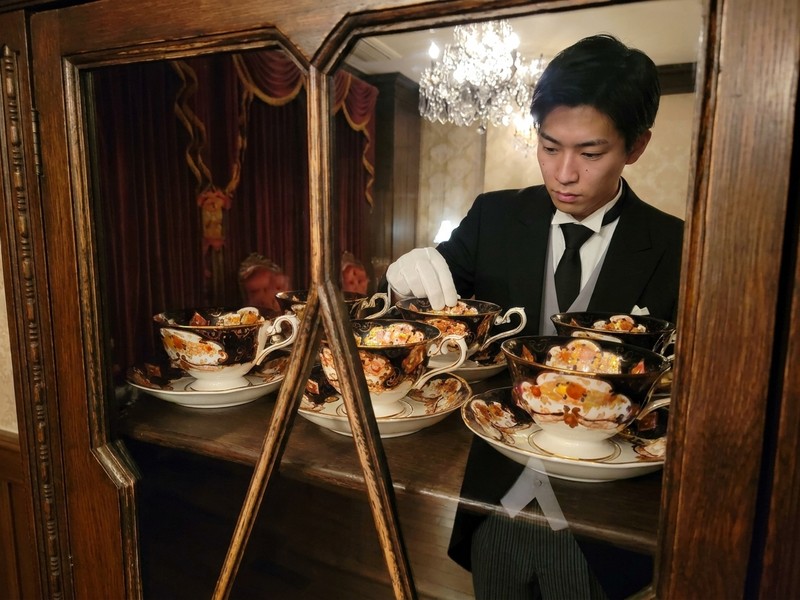
Training the Mastery of Form
Hospitality is not an innate talent. We believe that through observation, preparation, and deliberate repetition of technique, anyone can acquire it as a genuine skill.
Education at The Japan Butler Academy is not a place for abstract sermons on the spirit of service — it is a place to train the ability to express that spirit in concrete, reproducible actions: the mastery of form.
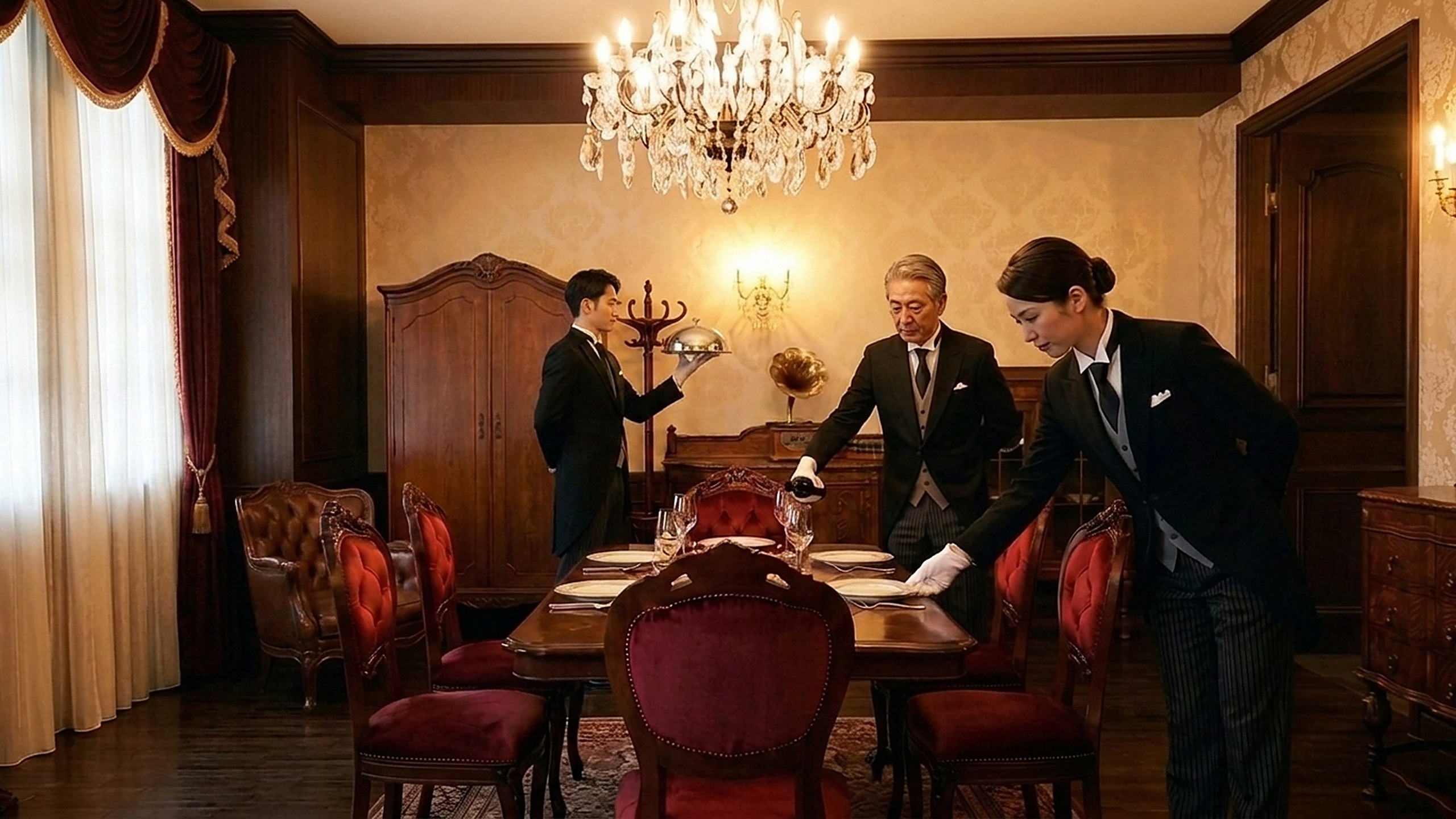
Integrating Skill and Character
Yet technique alone cannot make a true butler. The ability to stand in another's shoes, to anticipate a need before it is voiced, to guard confidences absolutely — it is only on this foundation of character that technique transforms from mere form into genuine hospitality. Every lesson we offer is designed to develop butlers in whom skill and character are fully integrated.

A Philosophy That Extends to Corporate Training
This philosophy does not stop at our core programmes. The same thinking runs through the hospitality and business etiquette training we deliver to corporate clients: the perceptiveness to read ahead, the sensitivity to calibrate one's presence to each person, the conduct that never erodes trust. The essence of butler education is the very capability demanded across every professional service environment. Corporate training, however, does not confer a butler credential; it conveys these principles as practical hospitality skills.
In our classes on cultivating the anticipatory mindset, for example, students perform role-playing exercises in which they must act before the instructor gives any signal. By observing a guest's gestures and gaze and sensing what will be needed next, they learn to move naturally and instinctively — repeated training that builds a body that anticipates without conscious thought.
OUR APPROACH
Three Educational Principles
Three Educational Principles
Three principles underpin everything we do in the classroom to bring our philosophy to life. They are woven into every moment of every lesson.
Practice-Rooted Learning
We never stop at the lecture. After understanding why a technique is necessary, students apply it by moving their bodies, then develop their situational judgement through role-playing that closely mirrors real practice.
Knowing with the mind and the body together is what allows instant, reliable reproduction in the field.
Individual Instruction Only Small Groups Can Deliver
With a strict maximum of six students per class, instructors examine every detail of each student's technique and correct it on the spot. The angle of a hand, the distribution of weight in a stance, the direction of a glance — small habits that go unnoticed in larger classes are caught and corrected, guiding every student to confident mastery.
A Structured System Built Step by Step
Three progressive courses take students from fundamentals through management and crisis response.
The Essential course establishes the foundations of technique; the Advanced course broadens its application; the Master course refines management and decision-making.
Students may begin at any level and advance according to their own goals.
OUR VISION
The Butler We Aim to Develop
The Ideal Butler We Cultivate
We are developing butlers in whom skill and character are inseparable — professionals who combine flawless technique with the integrity to uphold confidentiality absolutely and the composure to judge every situation wisely.
Reliable Technical Skill
From tea service and table setting to wardrobe management and VIP reception — students acquire the full range of techniques a butler must master, with the ability to perform any of them flawlessly in any situation.
Refinement and Integrity
We value not only the beauty of technique but the character that sustains it. Genuine consideration for others and the composure to remain calm in any circumstances — these qualities are cultivated in every dimension of our instruction.
Confidentiality and Trust
The heart of a butler's professional ethics is the inviolable protection of all information entrusted to them. Through repeated emphasis on the importance of confidentiality, we foster the self-awareness of a professional who never betrays trust.
Situational Judgement
Rather than mechanically following a manual, students sharpen their ability to read the person, the setting, and the moment instantly, and to select the best course of action.
Role-playing across a wide range of scenarios builds genuine adaptability.
HOW WE TEACH
Our Teaching Method
The Learning Cycle
Learning never ends with listening. What is understood in the lecture is tested in hands-on practice, refined through role-playing, and completed through the instructor's feedback — a cycle repeated throughout.
Lecture
Students develop a theoretical understanding of why each technique exists — grounded in historical context, the principles of hospitality, and service philosophy — building the knowledge that underpins all practical skill.
Hands-On Practice
After watching the instructor's demonstration, students practise the technique repeatedly with their own bodies, converting understanding into capability — from "knowing" to "being able to do".
Role-Playing
In guest and butler roles, students sharpen their response skills in situations that closely replicate real practice. Repeated exercises build the ability to respond flexibly and effectively to the unexpected.
Feedback
The instructor examines each student's technique in detail, delivering specific, constructive guidance on areas to correct and directions for improvement. This reflective stage is the engine of consistent growth.
Lecture
Students develop a theoretical understanding of why each technique exists — grounded in historical context, the principles of hospitality, and service philosophy — building the knowledge that underpins all practical skill.
Hands-On Practice
After watching the instructor's demonstration, students practise the technique repeatedly with their own bodies, converting understanding into capability — from "knowing" to "being able to do".
Role-Playing
In guest and butler roles, students sharpen their response skills in situations that closely replicate real practice. Repeated exercises build the ability to respond flexibly and effectively to the unexpected.
Feedback
The instructor examines each student's technique in detail, delivering specific, constructive guidance on areas to correct and directions for improvement. This reflective stage is the engine of consistent growth.
At the conclusion of each course, students sit a practical examination, and those who pass receive an official butler credential from The All Japan Butler Association.
Learn more about the Certificate & CertificationFAQ
Frequently Asked Questions
Frequently Asked Questions
No. We treat hospitality as a trainable skill and deliver a structured programme focused on practical techniques, service, and response capability through hands-on instruction.
So that the instructor can examine and immediately correct every detail of each student's technique. We limit each class to a maximum of six students.
Yes. A practical examination is held at the conclusion of each course, and those who pass receive an Association-certified credential. Please see our Certificate and Certification page for full details.
For further enquiries, please use our contact form.
TAKE THE NEXT STEP
Feel free to reach out
If you have any questions about our courses or the enrolment process, please do not hesitate to contact us.
* Online consultations are also available.
LEARN MORE
Related Pages
Explore Further
About The All Japan Butler Association
Our parent organisation and the services we provide
Course Comparison
Compare our three courses at a glance
Curriculum Overview
The overall structure and approach to learning
Certificate & Certification
The Association credential earned upon completion
About the Academy
A full overview of the Academy
Last updated: 8 July 2026