
How to Become a Butler: A Complete Guide from Beginner to Professional
HOW TO BECOME A BUTLER
A clear, ordered guide to the knowledge, skills, learning methods, certification, and path into work required to become a butler, written so beginners can follow.
Beyond the glamorous image, it helps you think realistically from the true foundations of the role: discretion, observation, planning, and repeated practice.
DEFINITION
First Understand the Butler's Role
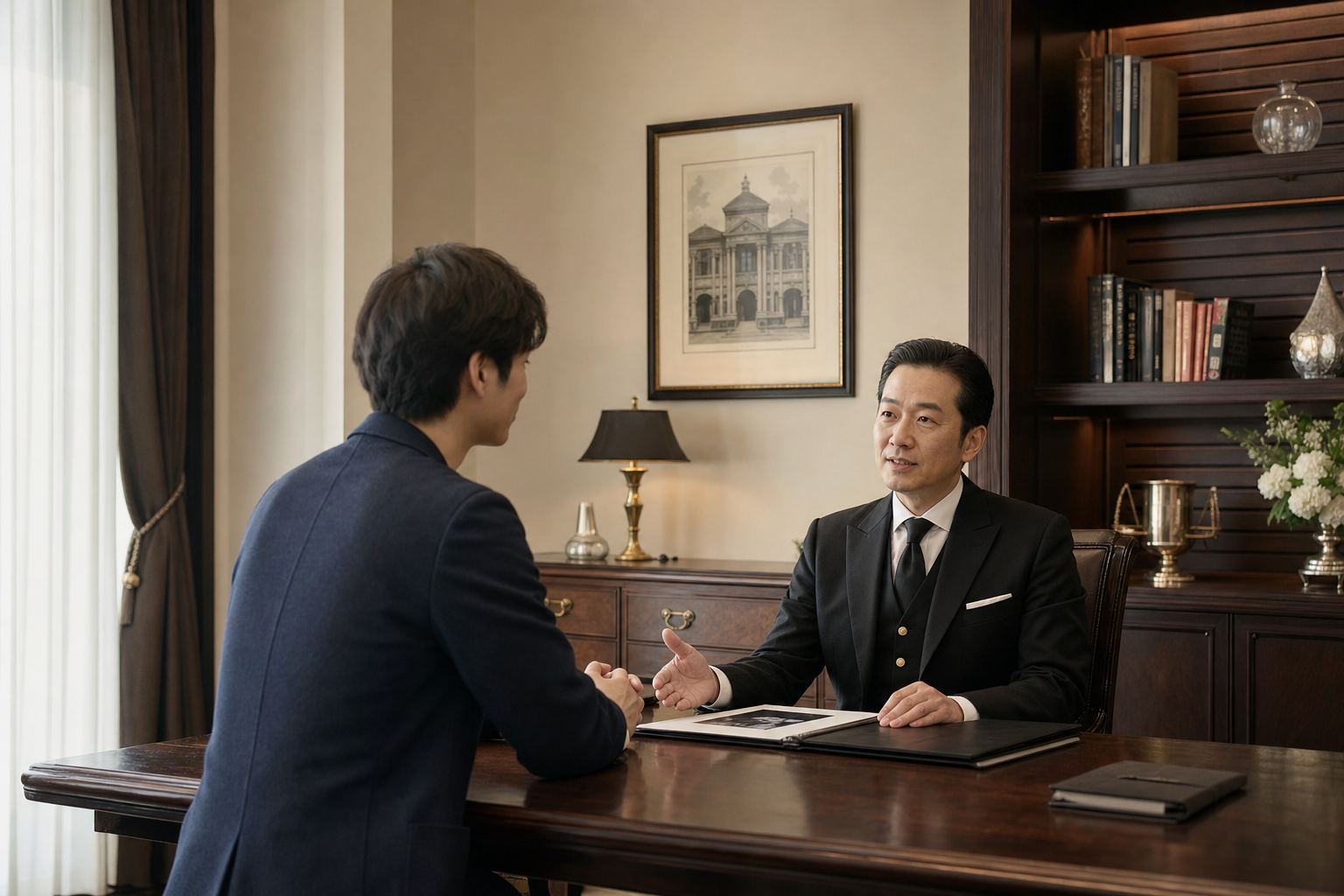
Before you aim to become a butler, do not judge the work only by the glamour shown in films and novels. In real settings the core task is to quietly organise the flow of an entire household and protect the client's time and peace of mind. Training begins by putting into words what you will and will not take on, so you start without costly misunderstandings.
Before you aim to become a butler, do not judge the work only by the glamour shown in films and novels. In real settings the core task is to quietly organise the flow of an entire household and protect the client's time and peace of mind. Training begins by putting into words what you will and will not take on, so you start without costly misunderstandings.
A Profession that Supports Whole-Household Living
A butler's role is not limited to a single domestic task. Guest reception, schedule coordination, supplies management, and preparation for meals or travel all cut across the points of daily life. You must see how each action links to the next appointment and to other people involved, and reduce friction before it appears. The foundation is not surface polish alone, but a steady design for the stability of the whole household.
Observation that Notices Needs before Orders
Excellent service is not born from waiting for instructions alone. From small cues such as expression, belongings, the state of a room, or a shift in the time of day, you anticipate the support that will be needed next.
Anticipation must never become imposition, so you also learn timing and distance when you check. Training that separates fact from guesswork, rather than asserting observations as certainty, is the base that protects trust.
Discretion and Appropriate Distance
Because you enter a private home and personal space, a firm resolve never to take what you see or hear outside is non-negotiable. Topics of conversation, the presence of guests, and daily habits learned on duty stay outside ordinary talk.
Equally important is a distance that does not confuse warmth with overfamiliarity. A habit of being courteous without intruding, and of delivering only necessary reports to the right person, helps the lessons take root even before enrolment.
APTITUDE
Foundational Qualities to Build
Before techniques are memorised, the quality of daily conduct is examined. Manner of speech, appearance, punctuality, and accurate records are basics checked in every workplace.
Growth speed depends less on talent than on whether you can calmly keep the same standards every day. In training, instructors value reproducible care over flashy results.

Before techniques are memorised, the quality of daily conduct is examined. Manner of speech, appearance, punctuality, and accurate records are basics checked in every workplace.
Growth speed depends less on talent than on whether you can calmly keep the same standards every day. In training, instructors value reproducible care over flashy results.
Precise Deportment and Speech
How you stand, walk, hand over an object, or open and close a door all shape the impression you give.
Volume and pace of voice and choice of polite language matter in the same way; correctness alone is not enough without composure suited to the setting.
Begin by repeating the form faithfully and noticing your own habits.
Graceful deportment is not acting; it is a practical skill for not disturbing those around you.
Habits of Planning and Record-Keeping
When several tasks overlap, managing them only in your head makes omissions likely. Deciding priorities, estimating time, and leaving a brief note of what was finished all support safety.
Records serve not only you but also handovers and reports. Early on, cultivate the habit of leaving a trail anyone can follow, rather than relying on perfect memory.
Composure and Flexible Response
Days that do not go to plan are exactly when calm judgement is required.
Unexpected guests, weather changes, and missing supplies happen routinely.
Instead of skipping steps in a rush, you need the ability to choose alternatives while keeping safety and courtesy intact.
By practising the habit of not displaying emotion excessively, organising the facts, and deciding the next move, you build the steadiness workplaces rely on.
LEARNING
Self-Study versus Structured Training
Books and videos can open the door to knowledge, yet angles of movement, tone of voice, and the reasons behind a judgement are hard to verify alone.
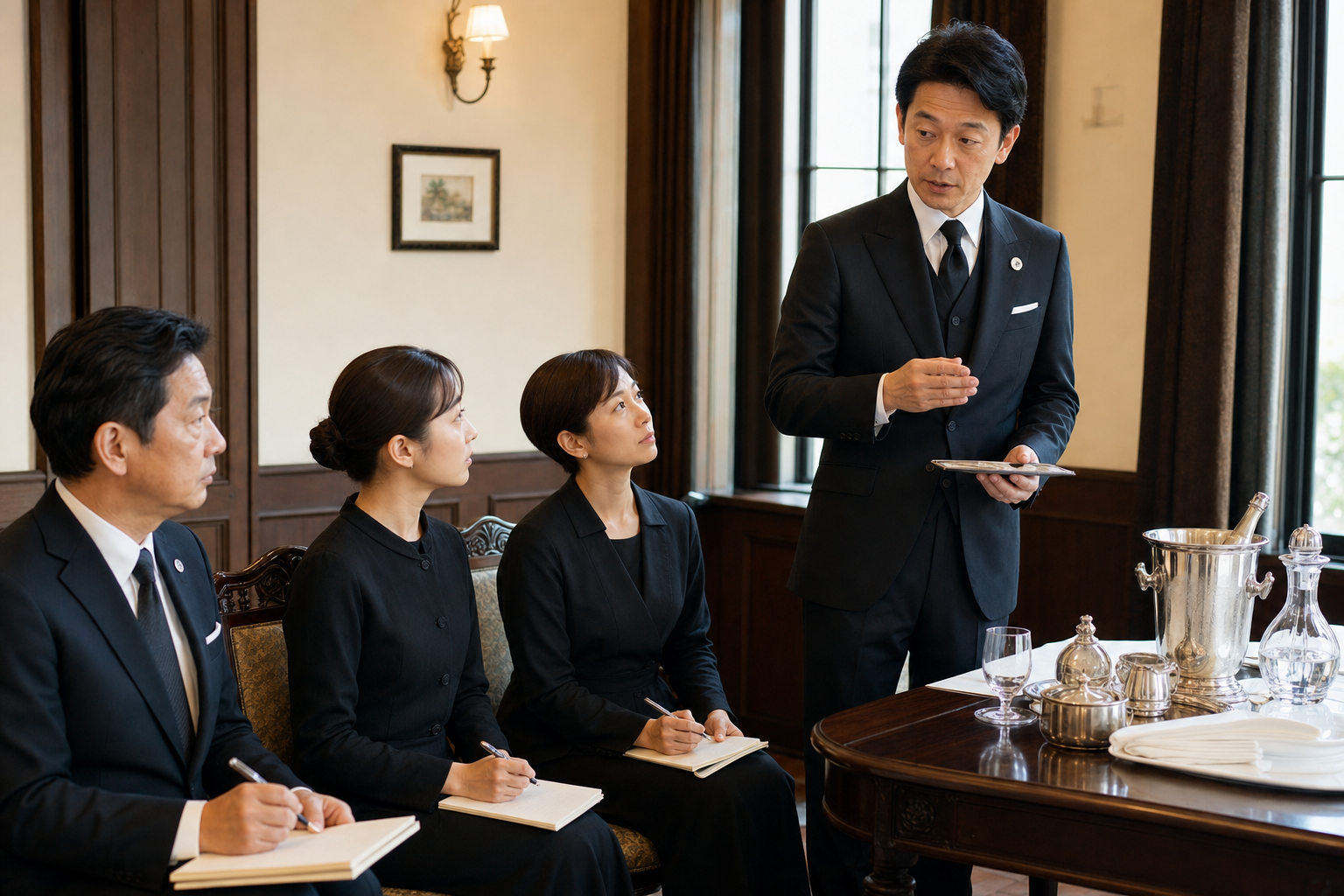
Structured training uses a cycle of demonstration, practice, critique, and repeat performance so self-taught drift can be corrected early.
For beginners especially, fixing the basics in an environment with objective eyes makes a decisive difference.
Books and videos can open the door to knowledge, yet angles of movement, tone of voice, and the reasons behind a judgement are hard to verify alone.
Structured training uses a cycle of demonstration, practice, critique, and repeat performance so self-taught drift can be corrected early.
For beginners especially, fixing the basics in an environment with objective eyes makes a decisive difference.
Learn Knowledge as a System
Etiquette, housekeeping, table service, care of clothing and equipment, and communication span many domains. Learned in fragments, it becomes unclear what should come first on site.
A curriculum treats related themes in order and explains why each procedure exists through both theory and cases. With a system behind you, even unfamiliar situations are easier to judge by returning to principle.
Build Practical Skill through Repetition
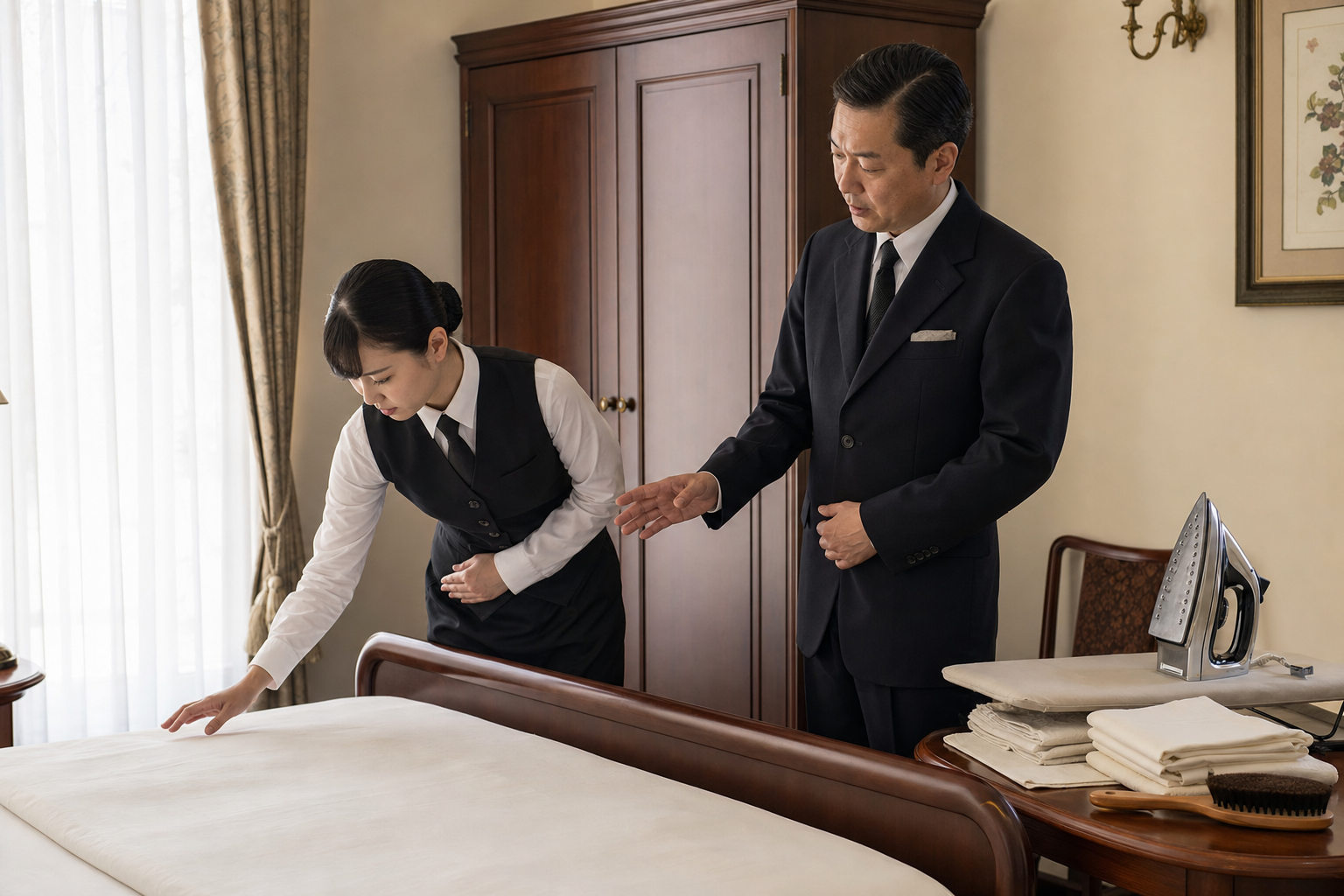
Content understood in the head is useless in practice if the body cannot keep up. Serving, escorting, cleaning routes, and handling luggage only stabilise after many repetitions.
Repeat the same tasks under changing conditions, prioritising accuracy and quietness over speed. A habit of returning to basics when tired produces skill that is less likely to collapse under real pressure.
Receive Feedback
Habits you cannot see yourself, and side effects of actions taken with good intent, often appear only when a third party points them out.
Receiving concrete points from an instructor and correcting them one by one in the next practice is the short path to improvement.
Treat critique as information that raises work quality, not as a personal attack.
How you ask questions is itself part of the craft you refine.
COURSES
Three Courses Matched to Your Stage
Three levels are offered according to depth of study: Essential, Advanced, and Master. Each combines classroom learning with practical work and leads to recognition matched to that stage on completion.
Choosing by your experience and the way you hope to work helps you avoid rushing ahead or advancing on thin foundations. Compare the intended outcomes of each course before you enrol.

Three levels are offered according to depth of study: Essential, Advanced, and Master. Each combines classroom learning with practical work and leads to recognition matched to that stage on completion.
Choosing by your experience and the way you hope to work helps you avoid rushing ahead or advancing on thin foundations. Compare the intended outcomes of each course before you enrol.
Essential Course
Essential runs for 8 days and 48 hours, concentrating on foundations such as etiquette, basic movement paths, appearance, and the form of reporting a butler needs. It suits beginners who first need a full picture of the work.
Completion recognition is Associate. Because the period is short, review after every session and repetition at home decide the result.
Master basic terms and safety checks so you are ready for the next stage of learning.
Advanced Course
Advanced runs for 12 days and 72 hours, building capacity for applied hospitality, complex planning, and handling several tasks at once in situations that easily become unstable on site.
After a full grasp of the basics, practical work deepens while you put the reasons for each judgement into words.
Completion recognition is Professional.
Across the longer practice hours you raise both speed and care, and the precision of information shared within a team.
Master Course
Master runs for 16 days and 96 hours, refining advanced situational judgement, a quality-management outlook, and the ability to show procedures to those who follow.
Training increasingly asks you not only to act yourself but to survey the whole setting and redesign priorities.
Completion recognition is Master.
The longer path also brings responsibility for managing your health and study plan.
The goal is not a finished state, but the ability to keep improving on your own.
ASSESSMENT
Assessment through to Completion
Learning outcomes are confirmed through attendance and examinations. The focus is whether content built in daily practice can be reproduced under set conditions.
Assessment is not a gate meant to fail you; it is a structure that makes gaps visible before you enter the field. Understanding the standards in advance and preparing on a plan makes it possible to sit the exams without panic.
Meet the Attendance Requirement
Completion requires attendance of at least 80%. Practical skill settles in the body through continuous experience, so repeated absence easily breaks the chain of procedures.
Even when absence cannot be avoided, consult early and make a concrete plan to catch up. Treat attendance less as a mere duty and more as the minimum condition for repeating safe movement, and your approach to training will change.
Written and Practical Examinations
Evaluation uses a 30-minute written examination and a practical examination. The written paper checks understanding behind action: terms, the meaning of procedures, and key points of judgement.
The practical looks at whether you can carry out set tasks calmly while keeping courtesy and safety. The short path to a pass is not rote memory alone, but being able to explain why the order is what it is.
Retakes and Preparation
If you do not pass, one free retake is available.
Do not dwell on disappointment; use the time to review which criteria fell short and practise those points with focus.
Do not relax because a retake exists; aiming for reproducible quality on the first attempt fixes skill more securely.
On the day, organise your health and belongings and prepare to work with your usual breathing; that readiness is part of the evaluation too.
CERTIFICATION
What Certification Means and How to Use It
The certification earned after completion shows that you finished a defined programme of education and passed the set evaluation.
The title itself does not guarantee work; it is material for explaining to a third party what you studied and at what standard it was confirmed.
Understanding how to use it correctly, without overstating or understating it, supports trust afterward.
Standing as a Private Certification
Certification linked to completion at this school is private certification by the All Japan Butler Association. It is not a national qualification, so it does not mean a legally reserved occupation or a public licence to work.
Even so, because the scope of study and the evaluation standards are stated clearly, it explains more than a self-taught claim. When you describe it, do not hide the difference from public qualifications; add concrete detail about what you learned.
Proof that Explains Your Learning
In interviews and first meetings, persuasiveness grows when you can speak not only the certification name but which course you took, how many hours you studied, and what practical work you experienced.
Certification is a shared language at the entrance, not a substitute for working ability itself.
Like a portfolio, adding areas of strength and points still under improvement reduces mismatched expectations.
Do not stop at showing the proof; use it as the starting point for dialogue.
Keep Refining Skill after Graduation
Earning certification is a waypoint.
Styles of residence, client preferences, and seasonal events differ by workplace, so the forms taught at school are never enough on their own.
After graduation you still need to review basic movements regularly and keep learning changes in tools and manners.
The practice that preserves the value of certification over time is the habit of recording small failures and feeding them into the next response.
CAREER
Preparation that Leads toward Work
Connecting learning to work also requires preparation beyond technique. You must make concrete which environment you will serve in and whose problems you will support, then translate your experience into words the other party can use.
A training institution does not promise employment; it is a place to ready foundations and professional attitude that hold up on site. With that premise shared, you design a realistic next step.

Connecting learning to work also requires preparation beyond technique. You must make concrete which environment you will serve in and whose problems you will support, then translate your experience into words the other party can use.
A training institution does not promise employment; it is a place to ready foundations and professional attitude that hold up on site. With that premise shared, you design a realistic next step.
Know Specific Places of Work
A butler's field is not limited to private homes alone. Management of a second residence, households with frequent guests, and settings close to daily support for an older client each shift the balance of what is required. List conditions that suit you in light of your stamina, preferred hours, and capacity for discretion. Do not stop at a vague wish to become a butler; research until you can picture a typical day on site, which helps prevent mismatch.
Put Experience into Words
Past work in hospitality, administration, care, or domestic support may look distant, yet observation, planning, and careful reporting are common threads. On a resume or in an interview, state briefly and concretely the scope you handled, what you improved, and how you responded when trouble arose. Using terms gained in training to translate your strengths into a butler's context makes the story coherent even without prior butler experience.
No Guarantee of Employment
Completion and certification show learning outcomes; they are not a system that guarantees a job or a hire. Hiring conditions differ by employer and are judged on a mix of character, health, schedule fit, and performance in a trial period.
Understanding that there is no guarantee, then gathering information yourself, facing interviews, and planning extra practical experience when needed, is the surer path over the long term.
NEXT STEP
Steps You Can Begin Today
Once you have gathered information, break action into small units and begin. Rushing only the application creates more regret than clarifying your aim, comparing courses, and adjusting schedule and daily life in order.
What you can do today is organise your present situation and write down your questions. The more concrete the preparation, the more essential the checks you can make at briefings and individual consultations.
Clarify Your Aim and Starting Point
Write in your own words why you aim to become a butler and how far, over what period, you want to reach. Honestly inventory current work and family demands, stamina, and time you can give to study.
When only the ideal runs ahead, course choice and practice plans drift from reality. Placing the state you want beside your constraints reveals a learning pace you can sustain.
Read the Details and Compare
Read through public information on course hours, assessment methods, the standing of certification, and the absence of any job guarantee. List unclear points and confirm them through official guides or consultation.
Decide not by rumour or impression alone, but by whether you can continue the content every day. A comparison table reduces emotional judgement and lets you move to the next procedure with conviction.
Proceed to Application
When aim and conditions are set, follow the course guide into the application process. Confirm required documents, dates, and any materials to read in advance, and adjust your daily rhythm before the start date.
After applying, voluntarily tidy basic polite language and appearance so you can focus on practical work from day one. Even after you take the step, ask questions early and do not let learning stop.
Frequently Asked Questions about Becoming a Butler
Can beginners aim to become a butler?
Yes. You can learn step by step from the foundations. Do not judge only by age or background; confirm your purpose for learning and your will to keep practising.
How long is each course?
Essential is 8 days and 48 hours, Advanced is 12 days and 72 hours, and Master is 16 days and 96 hours.
What are the completion requirements?
Attendance of at least 80%, plus a 30-minute written examination and a practical examination. One free retake is available if you do not pass.
Is this a national qualification?
No. It is private certification by the All Japan Butler Association.
Does graduation guarantee employment?
There is no system that guarantees a job or a hire. Certification shows learning outcomes, and hiring conditions differ by employer.