

All Japan Butler Association
THE PARENT BODY OF THE ACADEMY
Counting from its founding in 1890, the association is 135 years old. Its work has been to raise butlers, measure their skill and certify it.
Every bow exchanged in the academy classroom and every examination taken after graduation rests on the standards this body has set. Here we read the organization from the learner side.
WHAT IT IS
The body that keeps the yardstick of the profession
Keeper of the standard
A profession with no public licence
There is no state licence for butlers. That is exactly why a yardstick is needed: who may call themselves a butler, and what level counts as fully trained.
The organization founded in 1890 by Shingo Tanaka has held that yardstick for 135 years and kept revising it.
English practice, fitted to Japanese homes
Tanaka studied in Britain and brought home the ways of the butler as practised in the great houses there. He did not simply transplant them.
He laid Japanese courtesy over Western service etiquette and assembled, from scratch, an image of the butler that fits life in Japan.
That editing work is the starting point of the association, and much of what appears in the academy textbooks today traces back to it.
The academy teaches the association standard
The first thing a prospective student should know is that the academy teaches the association standard. Class objectives, the marking of practical tests, certification after graduation: all of it sits inside a framework the association decided.
To learn about the association is to learn what you will be aiming at.
Its stated mission
To spread the professional attitude and mindset of the butler in society, and to raise the level of the service trades as a whole.
The future it pictures
A society in which the butler is an established profession, received with respect and working in many settings. The academy ideal of a profession judged by clear standards is the educational version of this picture.
FOUR CHAPTERS
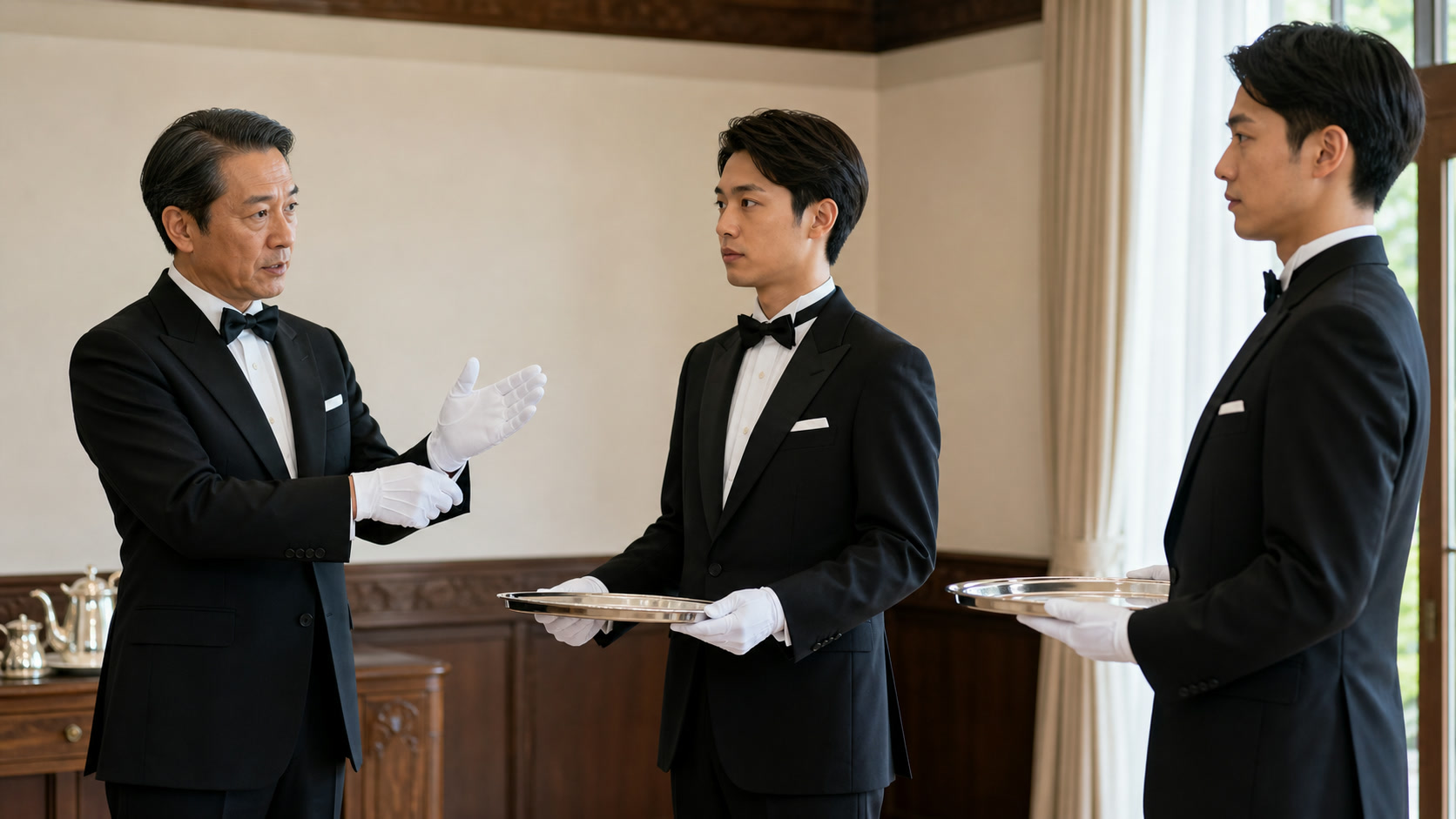
Founding, division, reunion, incorporation: a history in four chapters
135 years in four chapters
The road has not been smooth. There was a period when opinion split the body in two, a generation that put it back together, and a recent chapter in which it reorganized as a legal entity.
The nationwide standard taught at the academy is what came through those four chapters intact.
- 01
Chapter one: a Meiji founding and the first curriculum
In the middle of the westernization of the Meiji era, Shingo Tanaka established the association and opened the first structured course for butlers in Japan.
Instructors were invited from Britain, and Western service manners and Japanese courtesy were combined into one syllabus.
- 02
Chapter two: 1955, east and west part ways
A disagreement over how butlers should be trained split the association into a Kanto body and a Kansai body. For more than forty years the two raised butlers in their own ways and built regional standards.
- 03
Chapter three: 2000, one body again under the second head
Kazuhiko Yamada, the second head, compared the eastern and western practices item by item and in 2000 brought them back into a single national organization. The quality standard and training system that apply regardless of region were born here.
The common yardstick behind the three academy courses begins at this point.
- 04
Chapter four: a new chapter from 2023 and incorporation in 2025
In 2023 Yuichi Ishii, known as Butler Bell, became head. He published the roster of serving butlers, made fees visible and opened a desk that takes enquiries without an introduction.
On 19 February 2025 the association was registered as a general incorporated association with Ishii as representative director, the same year it reached 135 years since founding.

FIVE FIELDS
Five things the association does
Raise, recognize, convey, connect, record
It helps to think of the association work in five verbs: raise, recognize, convey, connect and record. The academy takes on the raising, in the form of a classroom, and graduates pass through recognition on their way into the world.

Raise: training and practice
A staged course that builds from basic deportment to specialist technique, with the Odaiba butler salon as the practice floor. Academy classes are an extension of that same floor.

Recognize: three tiers and specialist qualifications
Skill is certified at three levels, Associate, Professional and Master, with specialist qualifications in dining, travel and business manners on top. Examinations are held regularly in major cities and combine written and practical tests.

Convey: seminars for companies and individuals
Practical courses on leadership, hospitality and communication for companies and individuals, translating the bearing of the butler into something usable on the shop floor and in the office.

Connect: exchange with the world
Raising butlers who can receive guests from abroad, and keeping a door open to butler culture overseas. Sending out butlers who can work internationally is one of its declared aims.

Record: publishing and broadcasting
Through books, periodicals, social media and the Butler Bell YouTube channel it records the present state of butler culture and speaks to the public. Supervising the Gakken book on butler manners and culture belongs to this field.

Deliver: running a butler service
The association itself runs THE BUTLER, sending butlers to homes and companies for anything from a few hours to a long contract. This is where academy graduates actually work.
THREE TIERS
Three tiers of qualification, one staircase of learning
Associate / Professional / Master
A system that measures in stages
The qualification system measures the knowledge and skill of a butler in stages. By judging fairly against strict criteria it aims to lift the level of the whole trade and give the profession a clear outline.
The three tiers match the course design
What matters for the academy is that this three-step staircase maps exactly onto the course design. Essential looks toward Associate, Advanced toward Professional, and Master toward the top tier of the same name.
A student can see which step they are on and what is missing for the next, in terms the association itself uses.
The exam is not written work alone
Examinations take place several times a year in major cities and include practical tests as well as written ones.
Pouring tea and carrying a tray, repeated over and over in class, are not drills for their own sake; they are the very things the practical examination asks for.

HOW IT RUNS
Run by registered instructors and outside specialists
People behind the association
Leads for each field, linked side by side
The association is run by heads of each specialist field working side by side.
The representative director sets overall policy and serves as the contact point for related bodies in Japan and abroad; the vice chair supports that role and coordinates and supervises each project.
Four mechanisms behind the daily work
Day-to-day activity rests on a registered instructor scheme, advice from outside experts, partnerships with overseas organizations and contracted staff.
The instructors who teach at the academy share the association standard within that registered scheme, which is why the same level of instruction is available whichever classroom you sit in.
Four pillars, and where the classroom sits
There are four pillars of activity: certification, education and training, support for members, and research.
The academy is the institution that carries the second pillar, and graduates go on to draw on member support and research as their experience grows.




THE SALON
A butler salon like a castle room, in Odaiba
Headquarters
The head office in Aomi, Odaiba
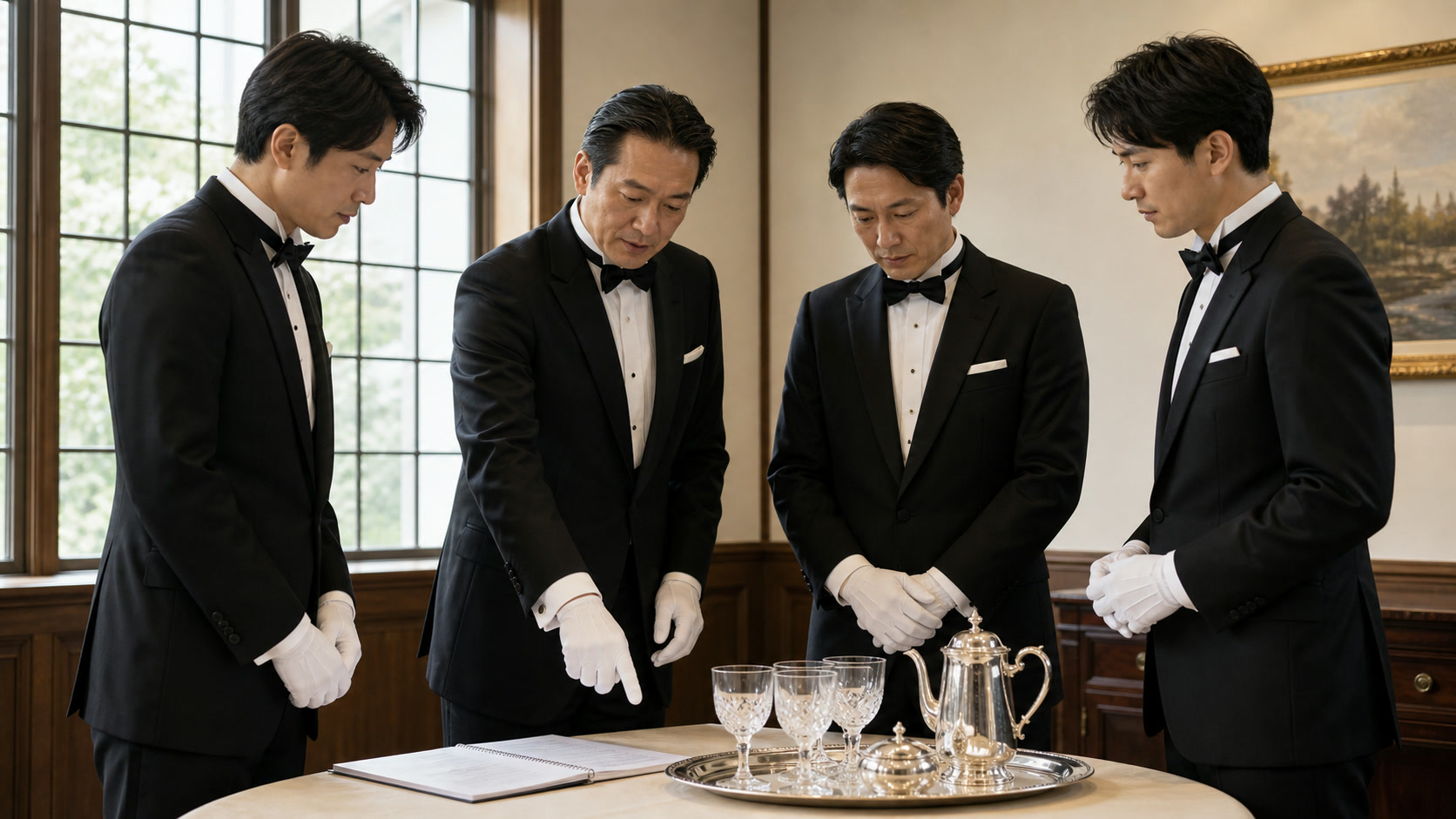
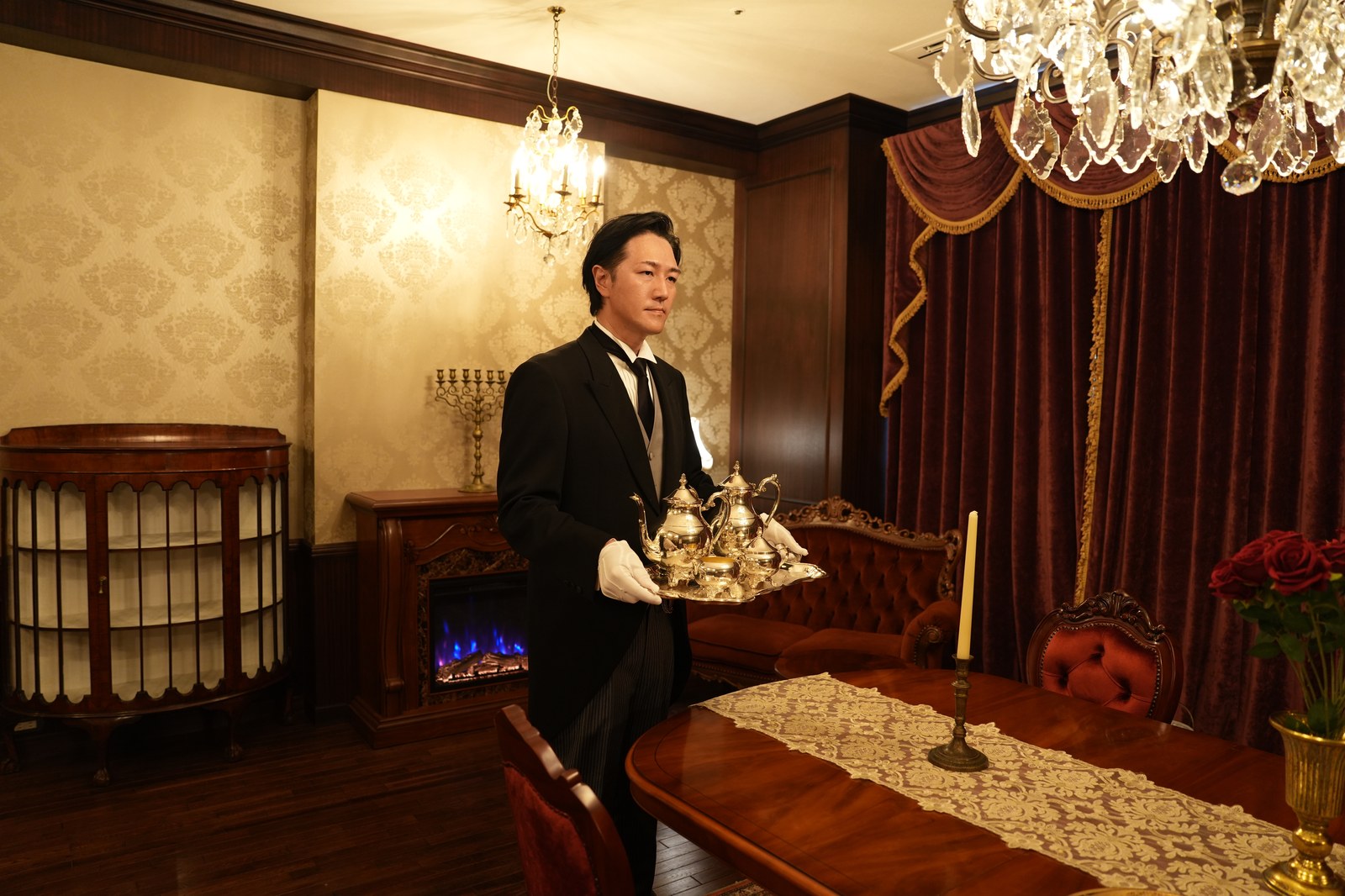
The headquarters is in Aomi, Odaiba, on the Tokyo waterfront, in a district that receives many visitors from overseas. Here the association keeps an office fitted out like a room in a medieval European castle, which it calls the butler salon.
Not a showroom but a room for practice
The salon is not a showroom but a practice space. How silver is laid, the angle at which tea is poured, where to stand when a guest arrives: what you read in a textbook is committed to the body here, surrounded by real furniture and fittings.
The room where academy students polish their practical work is this one.
Visits are by appointment
Visits require an appointment. If you want to discuss qualifications or the association, make contact first and then come.
Address
2-7-4 Aomi, Koto-ku, Tokyo 135-0064
Telephone
03-6824-4086 (all visits by appointment)

WHY WE INTRODUCE IT
The association, seen from the academy
What it means to a learner
The association as the parent body
The academy is an educational institution whose parent body is the association. Its three courses correspond to the three tiers of qualification, and graduates receive association certification before they begin to work.
Without the association standard, academy classes would lose the answer to the question of what they are practising for.
Turning the ideal into classroom language
Seen the other way, the academy is where the association philosophy is translated into classroom language.
An abstract mission such as spreading the butler mindset reaches a student only when it takes visible form: the angle at which a door is opened, the height at which a tray is held. The academy performs that translation every day.
Know the association before you enrol
If you are thinking of enrolling, first find out what kind of body the association is and by what standard it recognizes butlers. The official site carries the history, the qualification system and the activities in detail.
Come back to the course guide afterwards and each lesson will read differently.
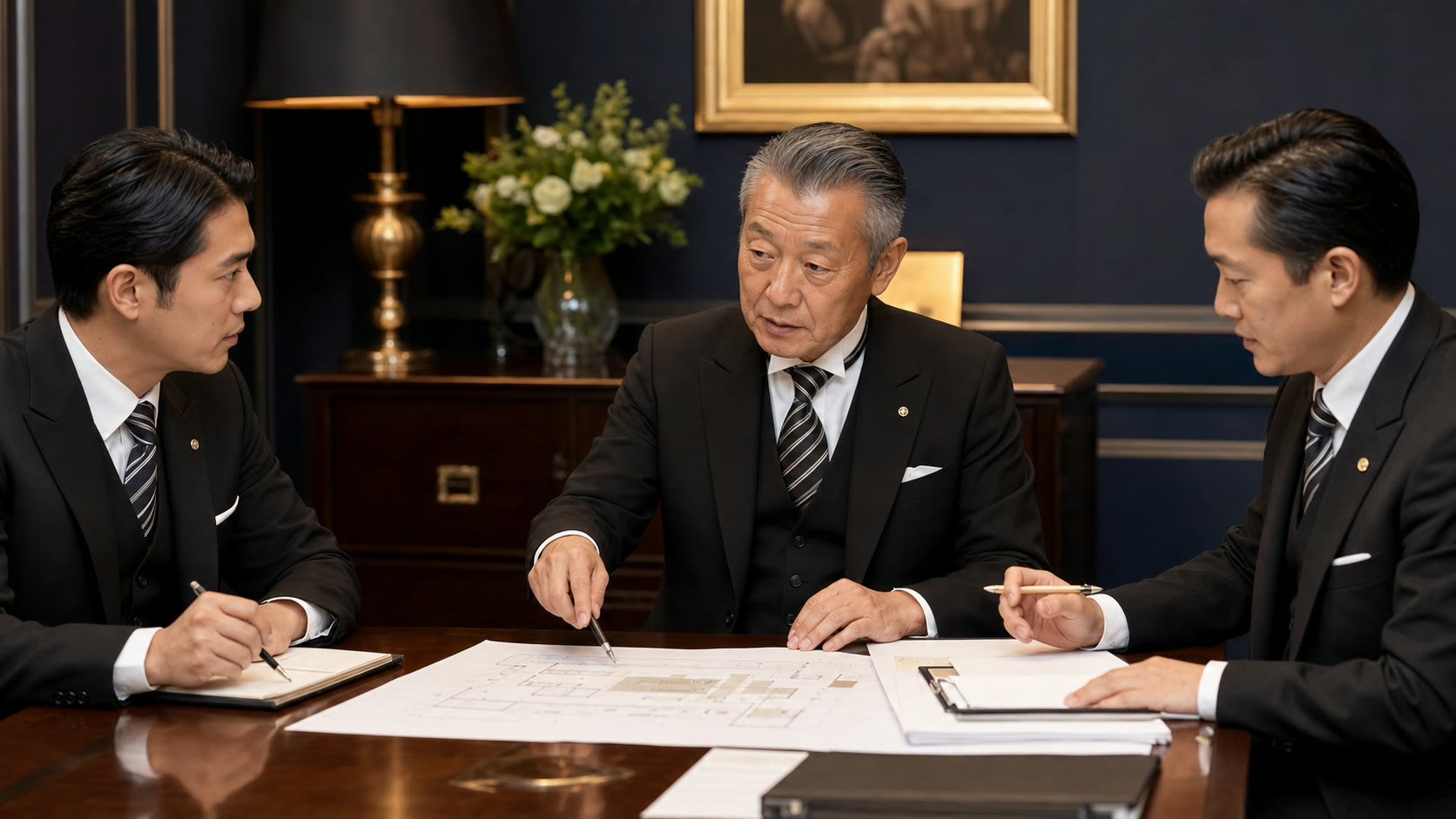
Leadership at the Master stage (association site)
AT EACH STAGE
Four points of contact: before, during, at the end, after
The association on a student timeline
Here is the relationship between the association and the academy laid out along a student timeline, so that you can picture in advance where the association will come into your path.
Before enrolling: learn the standard
Reading the qualification system and the mission first makes sense of the objectives written into the course guide. Have a look at the About section of the official site before your enrolment consultation.
During the course: practise to the standard
Each course is designed backwards from the certification criteria. When an instructor says this will be looked at in the examination, it is an association marking point.
At the end: be measured by the standard
You sit written and practical examinations and receive certification from the association. The certificate is proof that your skill meets a third-party standard.
After graduation: work under the standard
You start work as a certified butler, at the association butler service or in homes and companies. The standard remains a yardstick against which to measure yourself long after you begin.
GLOSSARY
Association words, translated into classroom words
Four terms you will hear in class
The words on the association site are the same words used in academy classes. Knowing them before you enrol makes the instructors easier to follow.
Head
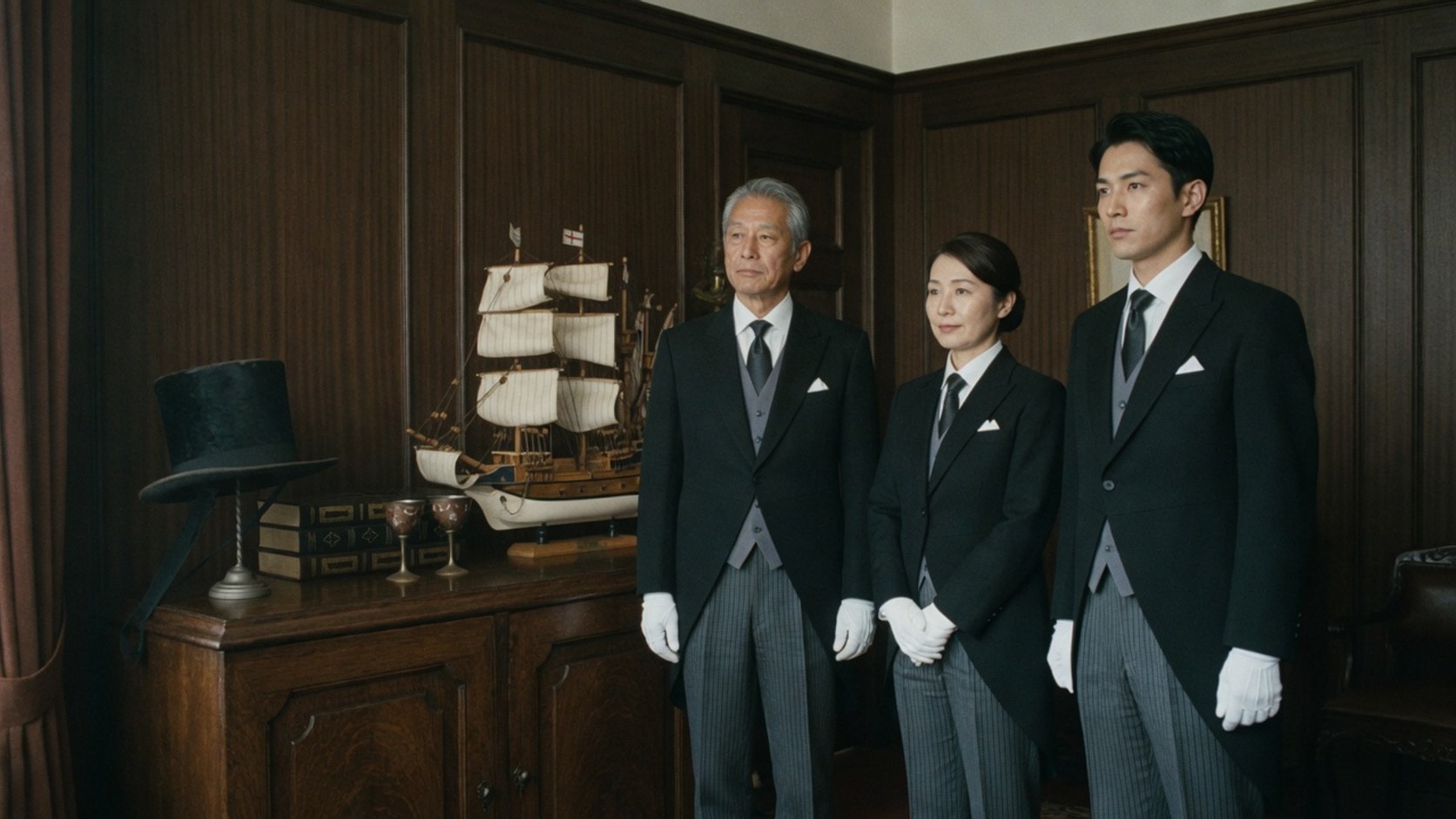
The title of the person who leads the association. The corporate title is representative director, and the post is held today by Yuichi Ishii, known as Butler Bell. When a class says the head, it means this person.
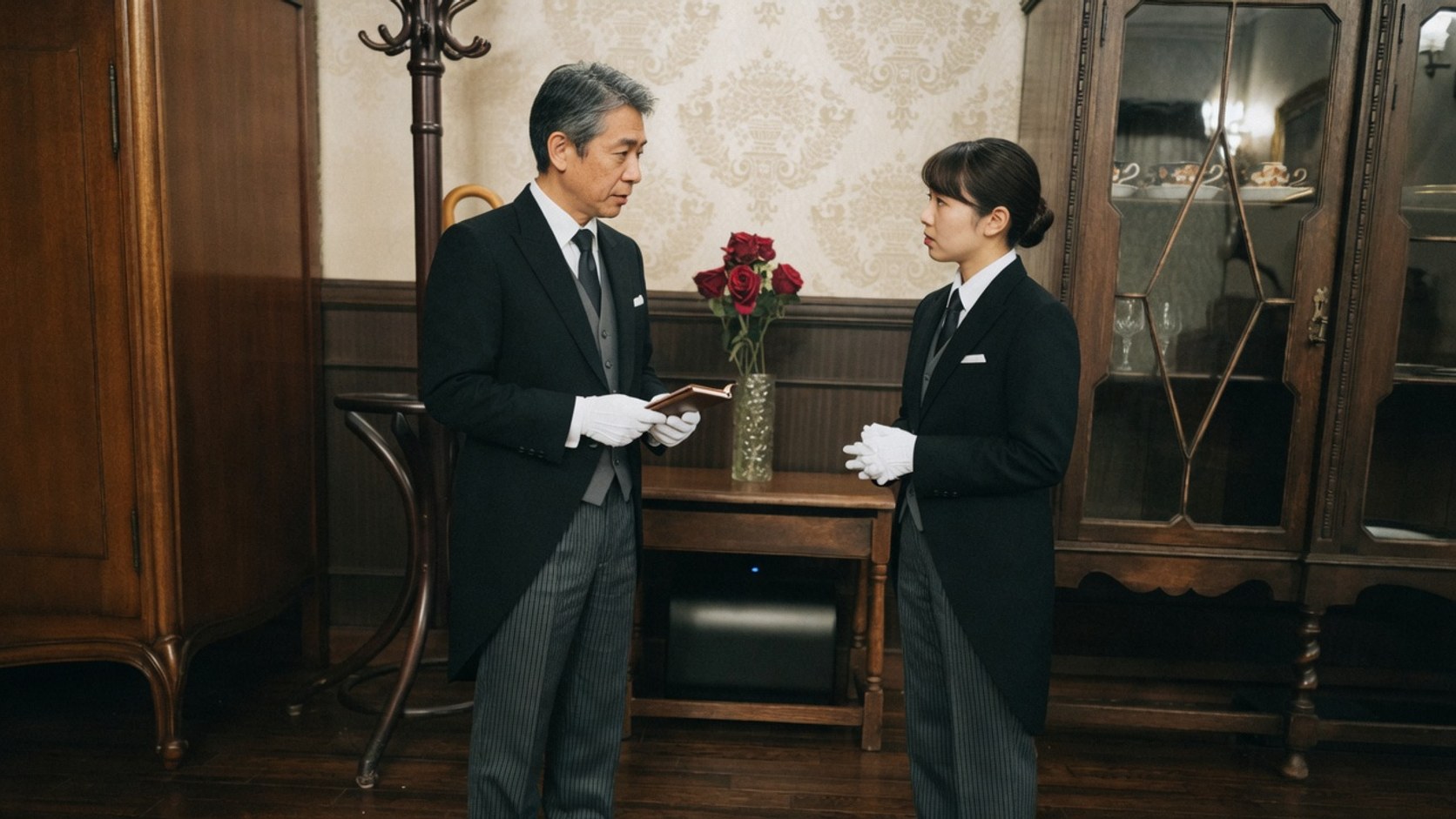
Certification
The mechanism by which the association measures and recognizes skill: three tiers plus specialist qualifications by field. The academy courses correspond to the former.

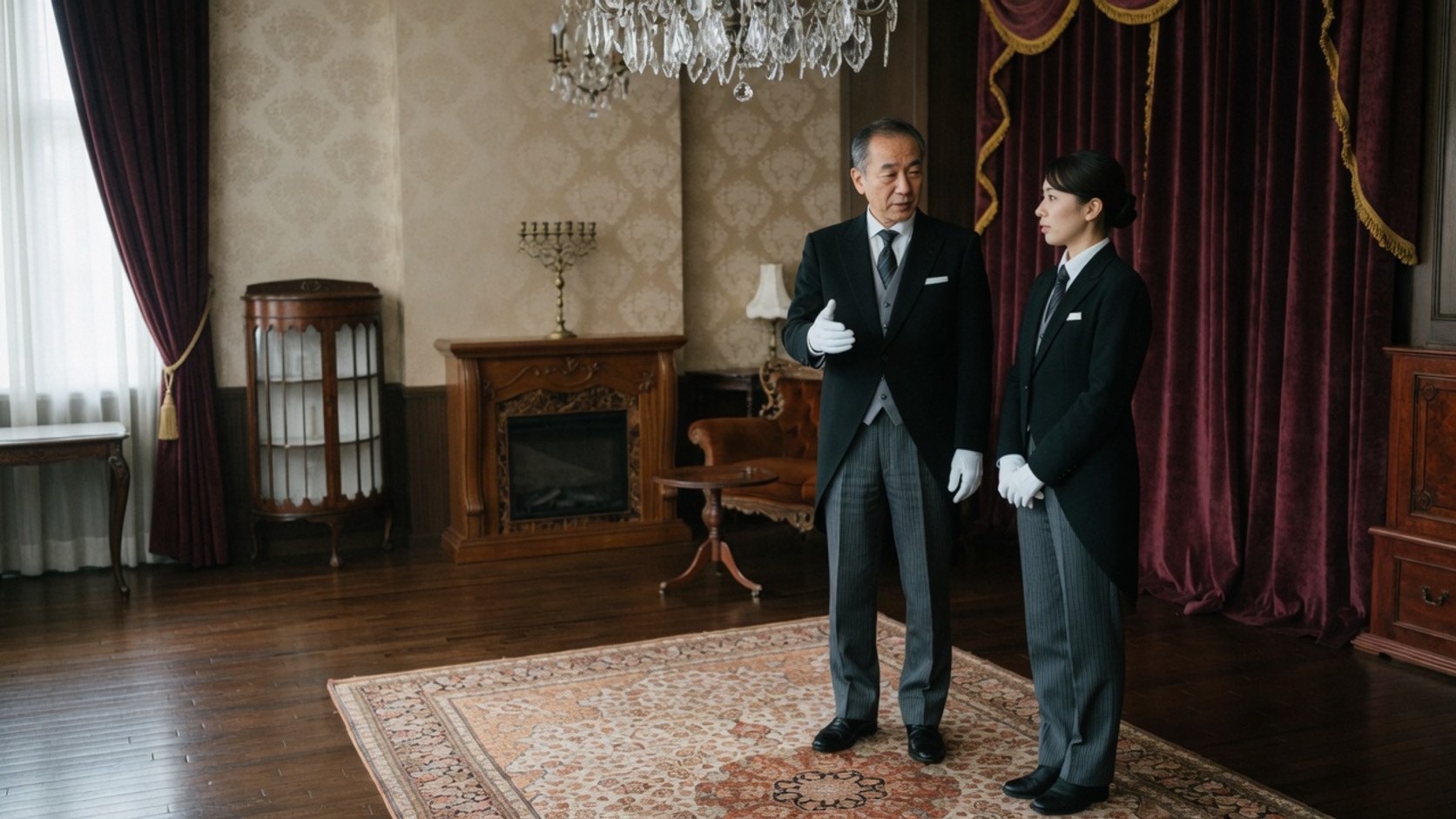
Butler salon
The practice room at the Aomi headquarters, fitted out like a room in a castle. Academy practical classes are held here. Visits are by appointment.
Standards
The code of conduct for butlers that the association publishes, arranged by topic such as deportment, grooming, confidentiality and crisis response. Class objectives are grounded in it.
READING THE SITE
Read the official site in this order and you will not get lost
A reading order for prospective students
The association site carries a great deal, and on a first visit it is hard to know where to begin.
At enrolment consultations we suggest About, then History, then Certification, then Standards: first how the body came to be, then the framework of the examination you will sit, and finally the daily code of conduct.
The history page lays out the milestones from founding to incorporation as a timeline. Read it first and it becomes clear, in sequence, why the nationwide standard dates from 2000 and why the roster was published in 2023.
The certification and standards pages are the source for the points an instructor will call examination material. You will return to them many times during the course, so bookmark them.

FROM THE INSTRUCTORS
How the instructors see the association
The association through an instructor eyes
Academy instructors teach within the association registered instructor scheme. To them the association is less an organization above them than the source of what they teach.
Every piece of deportment used in class is backed by an association standard, which is why an instructor can teach without hesitation.
A phrase the instructors often use is that the standard is what lets them be strict. They do not mark by personal taste; they assess against the items the association has set. For the student, what to fix in order to pass becomes clear.
At the same time the instructors stress that the standard is a floor, not a ceiling. Meeting it is the starting point; the care and ingenuity beyond it are built up by each person in the field.

COMMON MISREADINGS
Three things people often get wrong, cleared up first
Common misreadings about the association
The first is the idea that the association is a school. The school is the academy; the association sets the standard, certifies, and runs the butler service.
Applications for enrolment go to the academy, examination requirements come from the association: two separate desks.
The second is that a qualification automatically means working as an association butler. Certification proves skill; it is not a promise of work. Working at the butler service the association runs requires a separate procedure after certification.
The third is the assumption that the association has always been one body. In fact it spent more than forty years split between east and west before reuniting in 2000. Knowing that history gives the nationwide standard a different weight.

THE STANDARD IN PRACTICE
How a written standard turns into a grade
From one sentence to four things we watch
Prose alone cannot be taught
A standard written as prose cannot be taught as it stands. The first thing the academy does is take the sentence apart until every instructor would mark it the same way.
The phrase "carry it quietly" becomes four separate things to watch: the sound of the step, the height of the tray, where the eyes rest, and how fast the hand meets the table.
What we watch becomes the order of practice
Those four then become the order of practice. Asking a learner to correct everything at once leaves them unable to move, so we hand over one at a time: today only the footfall, next time only the level of the tray.
The movement is judged to meet the standard on the day all four hold together. The mark sheet is simply where that accumulation is recorded.
Why the pass line does not drift
The advantage of the standard living outside the classroom is that the pass line does not drift with whoever is teaching that day. Instructors change, terms change, but the places we look stay the same.
For learners that means being judged on the same points by any teacher; for us it is a brake against smuggling in our own habits.
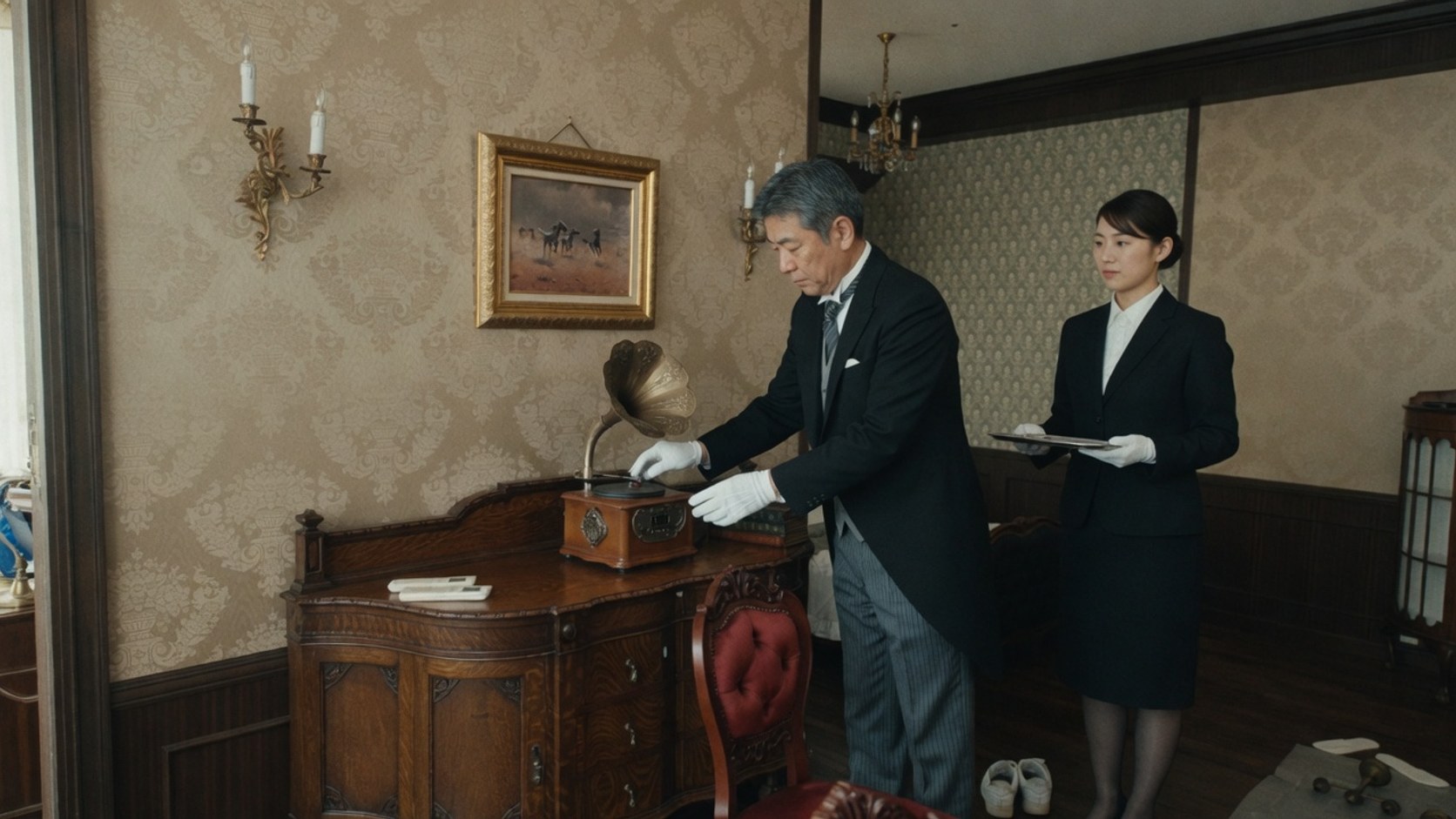
The association official site
Full history, qualification requirements, member information and requests for visits or interviews are on the official site. For enrolment enquiries, use the contact page on this site.
butler-association.jp — External site, opens in a new window
FAQ
Questions and answers
What people ask us
The association is the parent body and the academy is its education arm. Class objectives and certification after graduation all follow the association standard.
It was founded in 1890 and reached 135 years in 2025. On 19 February of that year it was registered as a general incorporated association.
Three: Associate, Professional and Master. In addition there are specialist qualifications by field, such as dining, travel and business manners.
Regularly in major cities, with both written and practical tests. Practical training at the academy is designed with these examinations in mind.
The headquarters at 2-7-4 Aomi, Koto-ku, Tokyo receives visitors by appointment. Call 03-6824-4086 in advance if you would like to visit or ask questions.
Yes. The association runs courses for companies on leadership and hospitality, which can be considered alongside the academy corporate training.
Yes. They are published on the official site and referred to in academy classes as the basis for objectives. Reading them before enrolment makes the purpose of each class easier to grasp.
Support for members is one of the association pillars of activity. The content and procedure are described on the official site; the academy desk does not handle them.
More related organizations
More from the group
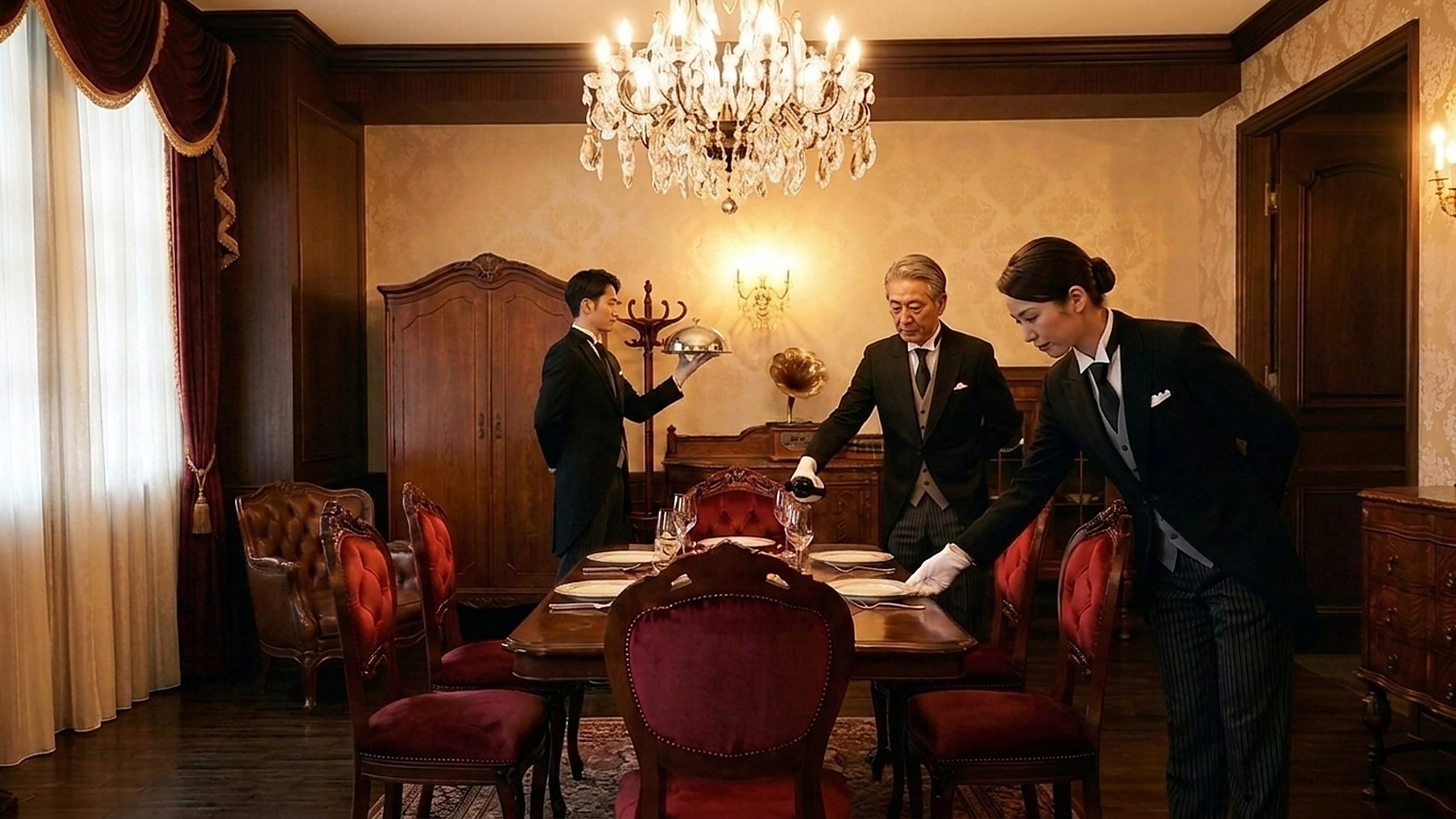
THE BUTLER
The butler service run by the association
Butler Bell
The head of the association, in his own words

Queen's Butler
A butler salon for women, run by the association

Family Romance Inc.
The family stand-in company founded by the head of the association

Yuichi Ishii official site
The head of the association as actor and entrepreneur
Curious about learning to be a butler?
Ask us anything about the courses, the association qualifications or corporate training. Brochures are free.
Last updated: 18 September 2026